

Google Cloud Managed MCP Servers for Databases
February 19, 2026
By Shivam Gautam

Google Cloud Just Changed the Game for AI Agents
Google Cloud just made managed MCP servers for databases available to every developer — and if you’re building AI agents, this is the announcement you’ve been waiting for.
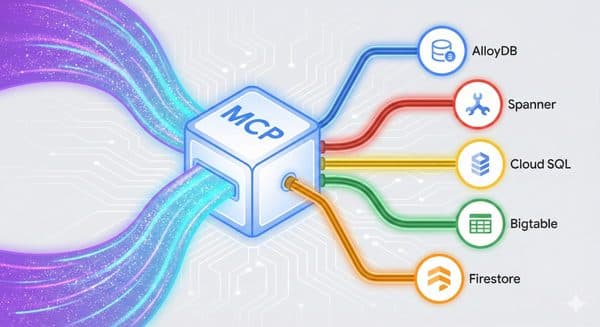
On February 19, 2026, Google quietly dropped one of the most significant infrastructure updates for AI agent development this year. They launched fully managed, remote MCP servers for AlloyDB, Spanner, Cloud SQL, Firestore, and Bigtable — meaning your AI agents can now talk directly to live production databases, securely, with zero infrastructure to manage.
Just point your agent at an endpoint, and it’s in.
What Are Managed MCP Servers for Databases — and Why Should You Care?
The Model Context Protocol (MCP) is the open standard that lets AI agents connect to tools and data sources in a consistent, secure way. Think of it as a universal plug for AI — instead of building a custom integration for every database, every API, every tool, you build once to the MCP standard and everything works together.
Until now, connecting agents to cloud databases still required non-trivial setup. You had to manage your own MCP server infrastructure, handle authentication, deal with connection pooling, and maintain it all as your agent workloads scaled.
Google Cloud’s announcement eliminates all of that. These are managed MCP servers for databases — Google runs them, secures them, and scales them. You get enterprise-grade AI-to-database connectivity as a fully managed service.
That’s a fundamentally different proposition. And it signals something important: MCP infrastructure is becoming a first-class cloud primitive.

The Five Database MCP Servers Google Launched
Here’s exactly what shipped, and what each server enables for your agents:
AlloyDB for PostgreSQL — Vector Search Meets Natural Language
AlloyDB’s MCP server gives agents direct access to PostgreSQL workloads. Agents can create and inspect schemas, diagnose slow queries, and — critically — run vector similarity searches. That last capability turns AlloyDB into a powerful backend for semantic search, RAG pipelines, and AI-native applications, all accessible through natural language instructions.
Spanner — Graph, Relational, and Semantic Data in One Query
Spanner is Google’s globally distributed relational database, and its MCP server unlocks something genuinely powerful: Spanner Graph. Agents can now traverse complex graph relationships alongside relational and semantic data in a single query using standard SQL and GQL. Fraud ring detection, real-time recommendations, and knowledge graph queries — previously these required specialist graph database tooling. Now they’re a natural language prompt away.
Cloud SQL — Your Entire Fleet, One Natural Language Interface
Cloud SQL covers PostgreSQL, MySQL, and SQL Server. Its MCP server lets developers and database administrators manage their entire fleet through conversational AI. Optimize a slow query, troubleshoot a connection issue, scaffold a new schema — all without leaving your agent interface or memorizing complex CLI syntax. This is particularly valuable for teams managing large, heterogeneous database environments.
Bigtable — High-Throughput Workloads, Agentically Automated
Bigtable handles the firehose: time-series data, digital integration hubs, IoT streams, event logs. Its flexible schema and extreme throughput make it the backbone of many operational platforms. With an MCP server in front of it, agents can automate workflows that previously required custom application code — think agentic customer support systems, supply chain monitoring, and real-time operational dashboards.
Firestore — Live Data for Mobile and Web Agents
Firestore’s MCP server is built for the mobile and web developer workflow. Agents can sync with live document collections, check real-time session states, verify order statuses, and respond to dynamic data changes — all through natural language. For product teams building AI features directly into their apps, this dramatically shortens the feedback loop.
Bonus: Developer Knowledge MCP Server
Google also shipped a Developer Knowledge MCP Server that connects IDEs directly to Google’s official documentation. Agents can now answer technical questions and troubleshoot code with accurate, up-to-date context pulled straight from the source. No more hallucinated API signatures.
Zero Infrastructure. Just Configure and Query.
This is the part that deserves to be said clearly: you don’t deploy anything.
There’s no server to provision, no certificate to rotate, no autoscaling policy to configure. You add the MCP server endpoint to your agent configuration, authenticate through Google Cloud IAM, and you’re immediately talking to your database.
For teams that have been hesitant to let agents touch production data because of the operational overhead involved, this removes the last major excuse. The infrastructure problem is solved. What’s left is the agent design problem — which is a much more interesting problem to have.
Enterprise Security That Doesn’t Get in the Way
Connecting AI agents to production databases raises legitimate security questions. Google Cloud addressed them directly, and the answers are solid:
Identity-first security via IAM. There are no shared API keys or service account credentials floating around. Every agent authenticates through Google Cloud’s IAM. Agents can only access the specific tables, views, or collections that are explicitly authorized — nothing more, nothing less.
Complete audit logging via Cloud Audit Logs. Every single query, every action, every database interaction an agent makes is logged. Security and compliance teams get full visibility into what agents are doing without having to instrument anything themselves.
This matters enormously for enterprise adoption. The #1 concern we hear from businesses evaluating AI agents is: “How do we know what it did?” With Cloud Audit Logs capturing everything, that question has a clean, auditable answer.
Works With Claude, MCPfy, and Every MCP-Compatible Client
Here’s the part that makes this announcement bigger than just a Google Cloud story: these servers are open standard.
Because Google built them on MCP — not a proprietary protocol — they work with any MCP-compatible client. Google specifically called out Anthropic’s Claude as a supported client. You connect by adding a Custom Connector in Claude’s settings and pointing it at your Google Cloud database endpoint. No complex configuration required.
This is exactly how the MCP ecosystem is supposed to work. An agent built for one tool can plug into another without rebuilding the integration from scratch. The model doesn’t matter. The vendor doesn’t matter. The protocol handles the handshake.
At MCPfy, this open-standard future is what we’ve been building toward. Our platform lets you create and deploy MCP servers for your own data — your internal databases, your SaaS tools, your proprietary APIs — with the same managed, enterprise-grade approach that Google Cloud is now bringing to its own database services. You don’t have to be Google to give your AI agents secure, production-ready access to your data. That’s exactly what MCPfy exists for.
What’s Coming Next From Google Cloud
Google has confirmed a roadmap that extends managed MCP support to Looker, Database Migration Service, BigQuery Migration Service, Memorystore, Pub/Sub, Kafka, and more.
Read that list carefully. Looker means agents will query BI dashboards and metrics directly. Pub/Sub and Kafka mean agents will consume real-time event streams. Database Migration Service means agents will orchestrate database migrations autonomously.
The vision Google is building toward is an agent that doesn’t just answer questions about your data — it manages your entire data infrastructure, end to end, through natural language.
The Bigger Signal: MCP Is Now Core Cloud Infrastructure
When a hyperscaler ships managed MCP servers for databases across its entire portfolio, it’s not a product announcement. It’s a statement about what AI infrastructure looks like going forward.
MCP is becoming what REST was for APIs a decade ago — the default integration layer. The teams that build their AI agent architectures around it now will have a significant head start on those who wait.
For businesses, the question is no longer whether to adopt MCP. It’s how fast you can make your data MCP-accessible — and how much of that work you want to manage yourself.
Make Your Business Data AI-Ready with MCPfy
MCPfy gives you the same managed MCP server experience for your own data that Google Cloud now offers for its databases.
Connect your internal databases, REST APIs, CRMs, and SaaS tools to any AI agent — Claude, Gemini, GPT-4, or your own model — through a single, secure, HIPAA and GDPR compliant MCP platform. No infrastructure to manage. No custom integration code to write.
Your data, MCP-ready, in minutes.